 Converter
Number Systems Converter
Convert exact signed integers among binary, octal, decimal, and hexadecimal, or encode text through an explicit UTF-8 or ASCII profile.
Uses full-string validation and BigInt for numeric routes, strict UTF-8 bytes for text, and strict 7-bit ASCII where named.
What This Category Covers
- Binary, octal, decimal, and hexadecimal integers
- Digit validation and optional sign or prefix rules
- UTF-8 text and byte representations
- Strict ASCII conversion boundaries
- Exact BigInt arithmetic for supported integer routes
Common Use Cases
- Numeric base conversion does not round integers.
- Leading zeroes and fixed width are notation choices, not a different integer.
- Text-to-binary is UTF-8 encoding, not ordinary base conversion.
Quick Reference
| Task | Recommended Tool | Why It Helps |
|---|---|---|
| Read bits as an integer | Binary to Decimal | Use place values to interpret a bit pattern. |
| Write integers as bits | Decimal to Binary | Check bit width, padding, and powers of two. |
| Inspect HEX values | HEX to Decimal | Interpret A-F digits and optional 0x notation. |
| Compress bit patterns | Binary to HEX | Group binary digits into four-bit HEX chunks. |
Integer Value And Text Encoding Are Different
Binary, octal, decimal, and hexadecimal can represent the same signed integer. Numeric routes validate the complete string and use BigInt so values above JavaScript Number safe-integer range remain distinct.
Prefixes, case, leading zeroes, and fixed width are notation choices. Normalized output does not claim to preserve a register width or signed machine encoding such as twos complement.
Text-to-binary uses UTF-8 bytes. ASCII-to-HEX is deliberately strict 7-bit ASCII. Neither is ordinary numeric-base conversion.
Popular Number Systems Converter
Search In Library →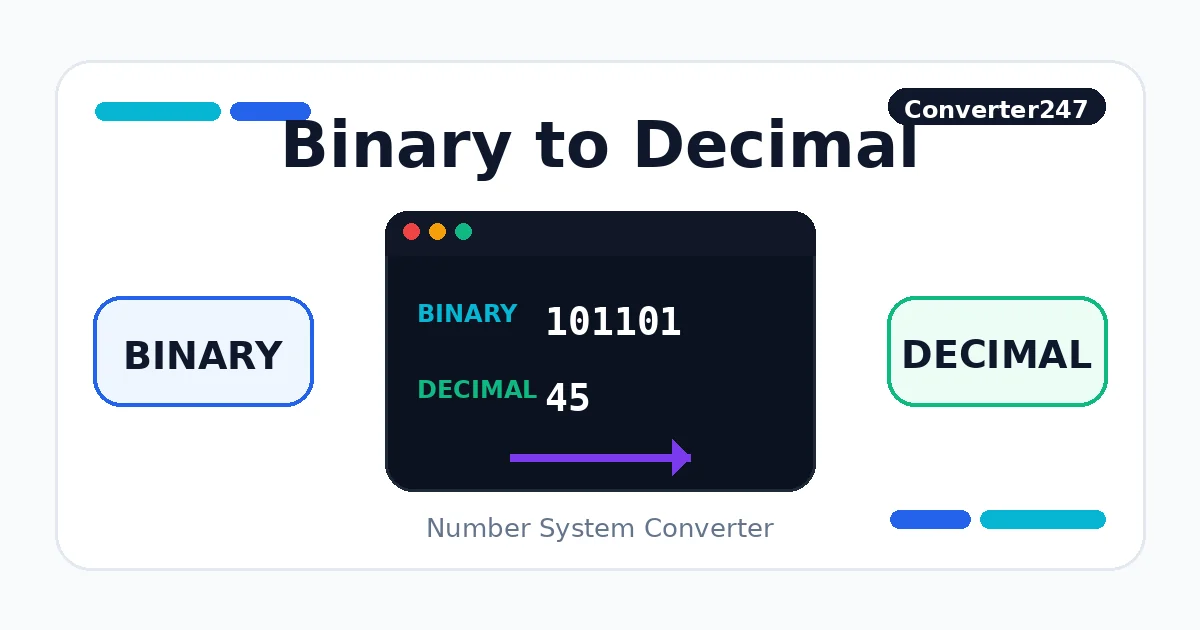 Number
Binary to Decimal
Translate one exact integer representation from base 2 to base 10. Signed whole-number grammar with optional matching 0b, 0o, or 0x prefix; output is normalized and hexadecimal is uppercase.
 Number
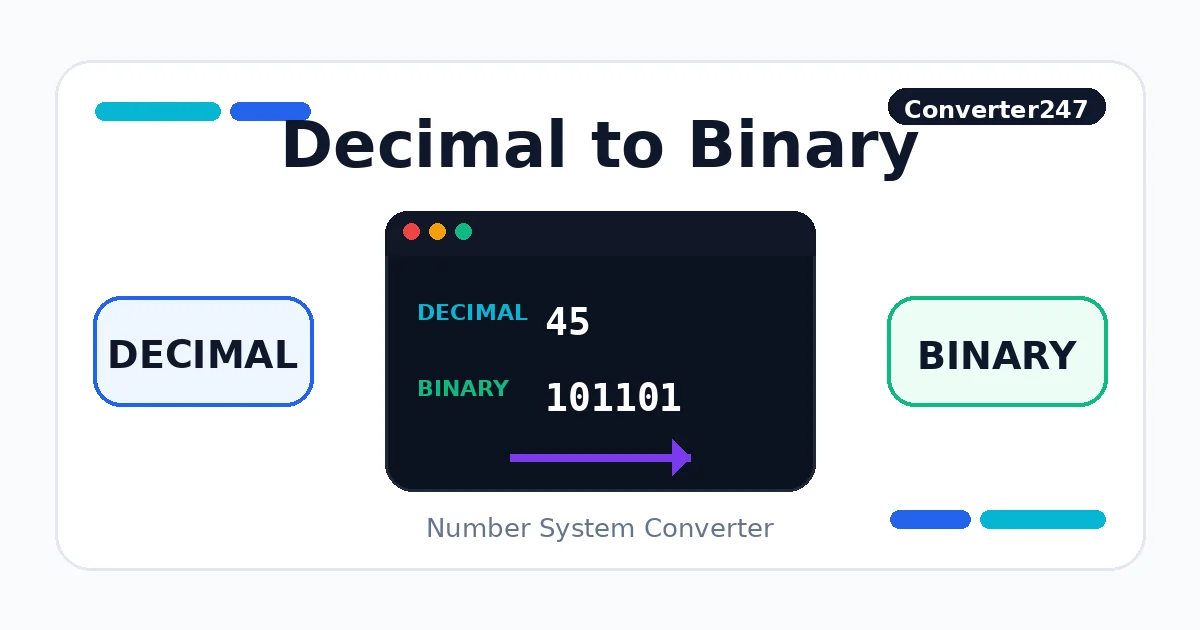
Decimal to Binary
Translate one exact integer representation from base 10 to base 2. Signed whole-number grammar with optional matching 0b, 0o, or 0x prefix; output is normalized and hexadecimal is uppercase.
 Number
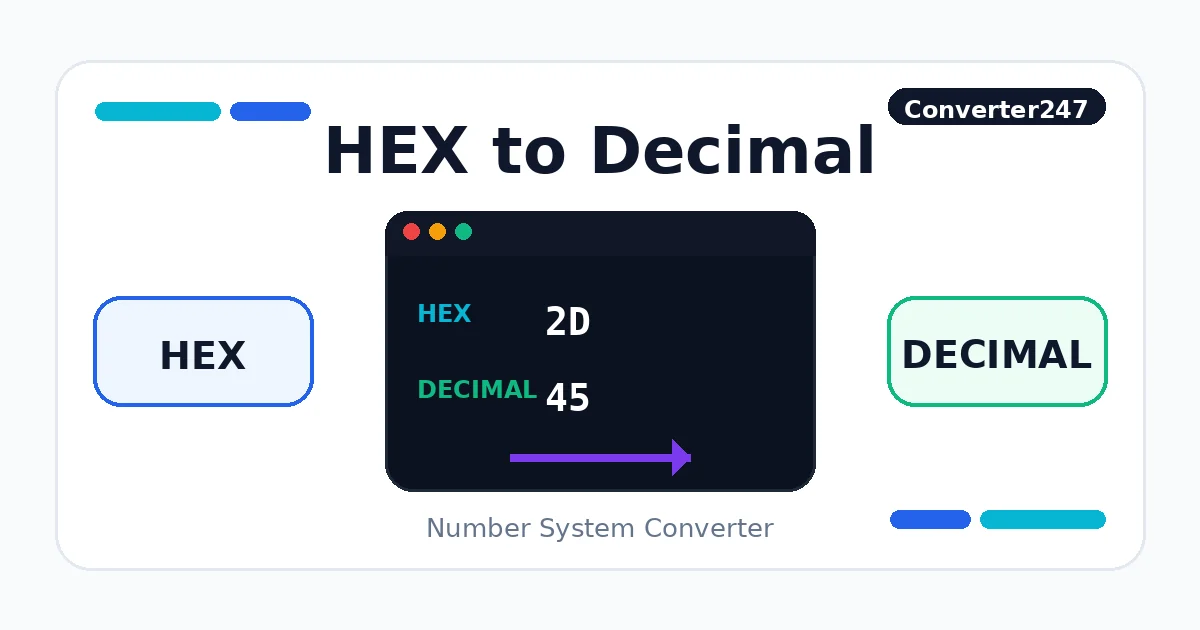
HEX to Decimal
Translate one exact integer representation from base 16 to base 10. Signed whole-number grammar with optional matching 0b, 0o, or 0x prefix; output is normalized and hexadecimal is uppercase.
 Number
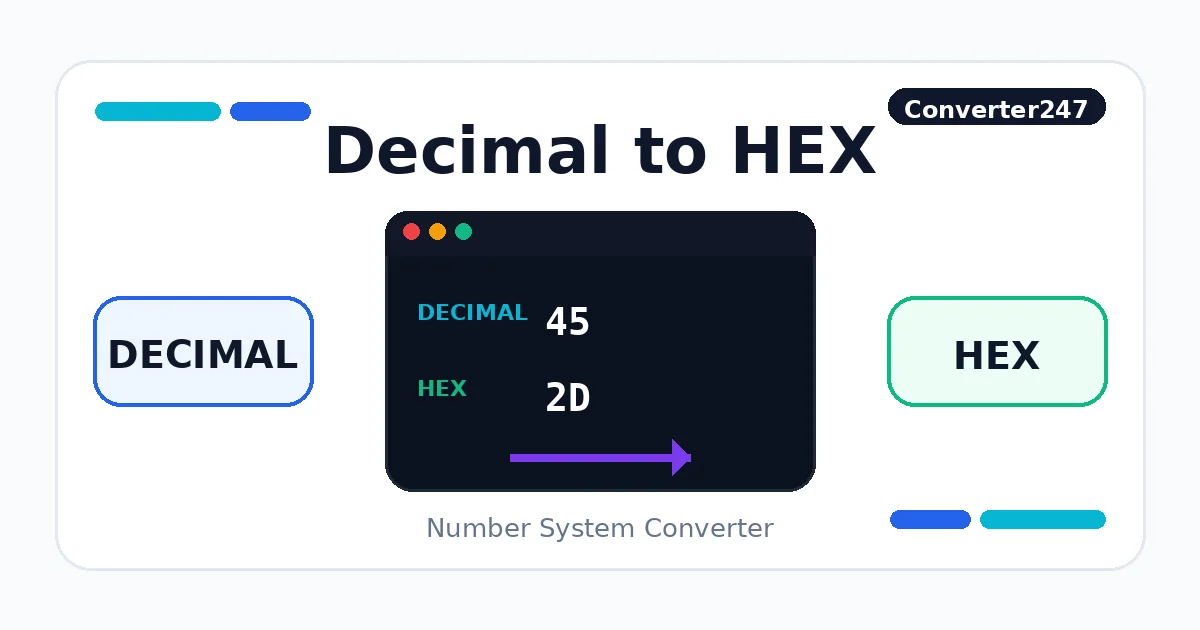
Decimal to HEX
Translate one exact integer representation from base 10 to base 16. Signed whole-number grammar with optional matching 0b, 0o, or 0x prefix; output is normalized and hexadecimal is uppercase.
 Number
Binary to Text
Decode complete 8-bit binary tokens as strict UTF-8. UTF-8 byte encoding; text is not ordinary numeric base conversion.
 Number
Text to Binary
Encode Unicode scalar text as UTF-8 bytes. UTF-8 byte encoding; text is not ordinary numeric base conversion.
Related Guides
These guides explain binary, decimal, octal, hexadecimal, ASCII, and text representation before values move between code and human-readable output.
All 16 Tools In This Category
Binary to Decimal
Translate one exact integer representation from base 2 to base 10. Signed whole-number grammar with optional matching 0b, 0o, or 0x prefix; output is normalized and hexadecimal is uppercase.
NumberDecimal to Binary
Translate one exact integer representation from base 10 to base 2. Signed whole-number grammar with optional matching 0b, 0o, or 0x prefix; output is normalized and hexadecimal is uppercase.
NumberHEX to Decimal
Translate one exact integer representation from base 16 to base 10. Signed whole-number grammar with optional matching 0b, 0o, or 0x prefix; output is normalized and hexadecimal is uppercase.
NumberDecimal to HEX
Translate one exact integer representation from base 10 to base 16. Signed whole-number grammar with optional matching 0b, 0o, or 0x prefix; output is normalized and hexadecimal is uppercase.
NumberBinary to HEX
Translate one exact integer representation from base 2 to base 16. Signed whole-number grammar with optional matching 0b, 0o, or 0x prefix; output is normalized and hexadecimal is uppercase.
NumberHEX to Binary
Translate one exact integer representation from base 16 to base 2. Signed whole-number grammar with optional matching 0b, 0o, or 0x prefix; output is normalized and hexadecimal is uppercase.
NumberOctal to Decimal
Translate one exact integer representation from base 8 to base 10. Signed whole-number grammar with optional matching 0b, 0o, or 0x prefix; output is normalized and hexadecimal is uppercase.
NumberDecimal to Octal
Translate one exact integer representation from base 10 to base 8. Signed whole-number grammar with optional matching 0b, 0o, or 0x prefix; output is normalized and hexadecimal is uppercase.
NumberBinary to Octal
Translate one exact integer representation from base 2 to base 8. Signed whole-number grammar with optional matching 0b, 0o, or 0x prefix; output is normalized and hexadecimal is uppercase.
NumberOctal to Binary
Translate one exact integer representation from base 8 to base 2. Signed whole-number grammar with optional matching 0b, 0o, or 0x prefix; output is normalized and hexadecimal is uppercase.
NumberHEX to Octal
Translate one exact integer representation from base 16 to base 8. Signed whole-number grammar with optional matching 0b, 0o, or 0x prefix; output is normalized and hexadecimal is uppercase.
NumberOctal to HEX
Translate one exact integer representation from base 8 to base 16. Signed whole-number grammar with optional matching 0b, 0o, or 0x prefix; output is normalized and hexadecimal is uppercase.
NumberBinary to Text
Decode complete 8-bit binary tokens as strict UTF-8. UTF-8 byte encoding; text is not ordinary numeric base conversion.
NumberText to Binary
Encode Unicode scalar text as UTF-8 bytes. UTF-8 byte encoding; text is not ordinary numeric base conversion.
NumberASCII to HEX
Encode strict 7-bit ASCII as two-digit hexadecimal bytes. Strict 7-bit ASCII; non-ASCII Unicode text is rejected.
NumberHEX to ASCII
Decode two-digit hexadecimal bytes only when every byte is ASCII. Strict 7-bit ASCII; non-ASCII Unicode text is rejected.
Related Categories
Number Systems Converter FAQ
Each base uses different place values. Binary uses powers of 2, decimal uses powers of 10, octal uses powers of 8, and hexadecimal uses powers of 16.
They usually do not change the integer value, but they can communicate fixed width such as one byte, a register field, or a protocol value.
No. Text tools map characters to encoded values, while numeric base converters translate an integer between bases.